
AI agents that build institutional memory.
You describe the problem. WinDAGs builds the team.
Watch a real workflow decompose into specialist agents, execute in parallel waves, and recover from failure — all in real time.
You describe the problem. WinDAGs builds the team.
Specialist agents execute in parallel waves and recover from failure — all in real time.
Books teach what. People know when. We built tools for both.
Plain Sonnet sounds confident. Skills make sure it's right — so you don't burn Saturday debugging a hallucination. Two judges from two vendors agreed.
brew install curiositech/windags/windags. That's the install.
NOT SURE WHAT TO DO NEXT?
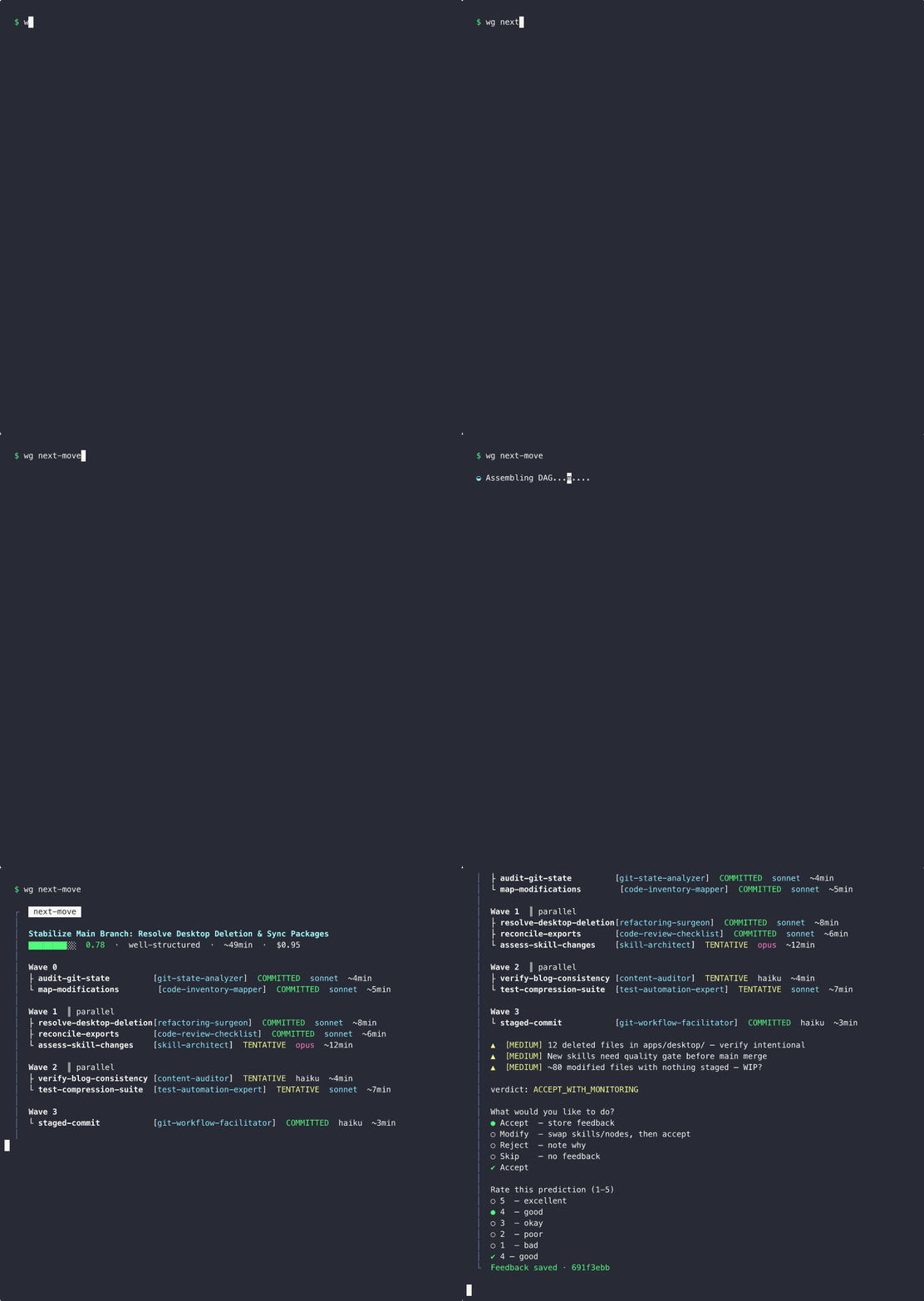
Next-Move looks at your project, recent files, git state, skills, and runtime setup, then suggests a path before anything runs.
THE SELECTION CASCADE
The first promise is simple: show the plan. When you want the deeper version, WinDAGs can also show how each node got its skill and why it belongs in the graph.
Generic output. No context.
Collocated, typed, coverage-aware.
THE PROBLEM WITH AI AGENTS
Today's agent frameworks give you parallelism without intelligence. Speed without safety. Here's what's missing.
NO LEARNING
Agents remember conversations but never learn which approaches actually work. No quality tracking. No skill ranking. Same strategy every time.
NO WARNING
Agents charge ahead without checking their work. No quality gates. No cost estimates. No approval step.
NO ADAPTATION
When something fails, the retry is identical. No strategy change. No fallback. Just the same mistake twice.
UNDER THE HOOD
Two views of the same intelligence — the learning pipeline and the live execution graph, running together.
The Understand phase activates — scanning your codebase for structure, patterns, and dependencies.
FOUR SUBSYSTEMS
Skill retrieval cascade, contradiction detection, cost gating, failure handling. Each one earns its place by catching a class of failure the others can't see.
LEARNING LOOP
Every accept/reject feeds two attribution stages — local k-NN (your history) and global priors (cross-user, opt-out) — that re-rank the skill cascade for similar future tasks. Six-stage retrieval (BM25 → Tool2Vec → RRF → cross-encoder → local k-NN → global priors) replaces the bandit approaches we tried first.
RISK ANALYSIS
Every node gets a risk score before execution. Contradiction detection catches conflicting agent outputs before they merge.
RESILIENCE
Exponential backoff, model fallbacks, and automatic retries. When node 7 fails, node 8 doesn't. The DAG adapts.
COST CONTROL
See estimated cost BEFORE execution. Set budgets per node. Model tier selection minimizes spend without sacrificing quality.
HONEST COMPARISON
We respect these frameworks. Here's where WinDAGs differs.
| Feature | WinDAGs | LangGraph | CrewAI | AutoGen |
|---|---|---|---|---|
| DAG-based task orchestration | ||||
| Cross-session memory | ||||
| Statistical skill quality learning | ||||
| 5-step skill selection cascade | ||||
| Human-in-the-loop gates | ||||
| Cost estimation before execution | ||||
| Contradiction detection | ||||
| Wave-based parallelism | ||||
| 200+ curated skill library | ||||
| Zero token overhead (CLI agents) | ||||
| Risk analysis per node | ||||
| Open source (BSL 1.1) |
Comparison based on public documentation as of Mar 2026. We may be wrong — PRs welcome.
HOW IT WORKS
From natural language to parallel execution in four steps.
DESCRIBE
Tell WinDAGs what you want in plain English. No jargon required.
DECOMPOSE
Your request gets broken into subtasks automatically. DAGs form.
MATCH
WinDAGs picks useful skills for each step. The technical ranking details are available when you need them.
EXECUTE
Agents run in parallel waves. Outputs flow forward. You stay in control.
551 SKILLS
ONE TEAM
Skills are expertise packages. They help an agent act less generic and more like the specialist the task needs. You can let WinDAGs match them automatically, then inspect the details.
Browse All SkillsBETA TESTING SPRING 2026
Be among the first to orchestrate AI agent teams with WinDAGs.
Join the beta and get early access to multi-agent DAG orchestration.
Request Early Access
Get notified when the beta launches. No spam.
WHAT IT ACTUALLY IS
A local-first DAG runtime for multi-agent workflows. Each box below maps to a concrete subsystem in the codebase.
Source-available under BSL 1.1. The whole retrieval pipeline is ~1500 lines of TypeScript. Read the code →
STAY IN THE LOOP
Get notified when the beta launches and when we ship new skills. No spam. Unsubscribe anytime.